The best brokers don’t have bigger books. They have books that compound.
This is how we think about it.

Spend more than five minutes on social media and you’ll find another guru that promises “7 hacks to 10x your business.” While it makes for viral content, those hacks won’t get you the European vacations you seek. It’s an unpopular opinion, but the key to growing a business is small, steady investments in relationships.
The gurus are trying to beat the market. However, in investing, chasing alpha usually ends in sleepless nights and buyer’s remorse. The smart money buys the index: own the whole market, keep contributing, and let compound interest do the work. Your book of business works the same way. Small, consistent investments across all relevant relationships, old and new, pay dividends for years.
I’ve seen it firsthand. I’ve built companies from the ground up, invested in properties out of state, and run a 400-unit co-op board in New York City. I’ve sent thousands of emails, hopped on hundreds of calls and done coffee dozens of times all in the pursuit of knowledge or a door to open. The lesson was always the same. The best opportunities came from people I already knew, or relationships I’d built over time.
Relationships are like salt. Nobody mentions them in the recipe for success, but without them the meal is ruined.
In the process of building Compai I’ve spoken with hundreds of folks, and the ones who get it fastest are the professionals who understand that the number of people they’d like to connect with is greater than the hours they have available. Research shows that human beings can reliably keep track of about 150 relationships at a time.1 Relationships above 150 don’t disappear. They go quiet. Most friendships don’t end suddenly. They fade as contact dwindles, one skipped catch-up at a time.2 Business relationships behave a lot more like friendships than family. Nobody owes you a call.
So the question isn’t how many people are in your book. It’s how many of them would think of you first when something changes. That’s the part that compounds.
“Online keeps you present. Offline makes it real.”
Not every touch is equal

Most outreach tools count touches, and measure success by how many emails they blast out. That paints an incomplete picture. A market update and grabbing coffee both count as “staying in touch,” but they carry different weight.
We believe touches come in three flavors:
- Light
An email, a text, an article you thought they’d enjoy, a comment on their LinkedIn post.
- Direct
A call, a handwritten note, a gift.
- Face-to-face
A coffee, a lunch, a tour, a dinner.
Light touches keep your name in front of them. Direct touches tell someone they matter to you specifically. Face-to-face is where relationships actually grow.
The rule we build around is simple: every light touch should be trying to earn a deeper one.
Your book has tiers
New. The people you want to know but haven’t met yet. We treat them as a relationship at zero, not a different playbook. Lead with something about them, keep it short, ask one question, then pick up the phone. Once someone has heard your voice, even on a voicemail, you stop being a name in their inbox and start being a person. Once you’ve reached out, they’re in your Book and hear from you next quarter, reply or not.
Dormant. The people who went quiet. Research on reconnecting with dormant ties found something surprising: old contacts often give you more than current ones, because they still trust you and they know things you don’t.3 One thoughtful note with a real reason is usually enough to restart the conversation.
Book. Everyone you’ve worked with, met, or pitched. They hear from you every quarter, with a real reason each time, and a call at least once a year.
Core. The fifty or so people who matter most right now. They hear from you every month, get a call every quarter, and sit across a table from you at least twice a year. Core has a cap, on purpose. Your face-to-face time is finite, and spreading it across everyone means nobody gets it.
Core isn’t a club. It’s a rotation. Anyone in your book can earn a seat. They reply, they take your call, they’re heading toward a decision, and you move them up. Close a deal together and they hold the seat for the year. And when a Core relationship has run its course, you move it back to Book. Not out. Just back.
You can’t predict the timing

Your book is full of timing: maturities, lease rolls, fund-ends, a partner retiring. This year alone, about 17% of commercial mortgage balances in the US come due.4 Every one of those is a decision, and every decision goes to whoever the owner thought of first.
You can’t know whose window opens this quarter. You can make sure you were in touch with all of them before it does. You don’t need to be in a deal to be ready for one. As they say in the sports world, the goal is to “stay ready so you don’t have to get ready.”
What a week looks like
For a book of 400, the method works out to roughly 40 light touches, 11 calls, and 2 coffees a week. The light touches are the least rewarding because you’re not having a two-way conversation human to human, but if you don’t lay groundwork with light touches, it’s unlikely a relationship will progress to direct touches.
One founder looking to raise more capital told me he knows the money is out there, but because he isn’t watering his relationships, his deals never grow in size.
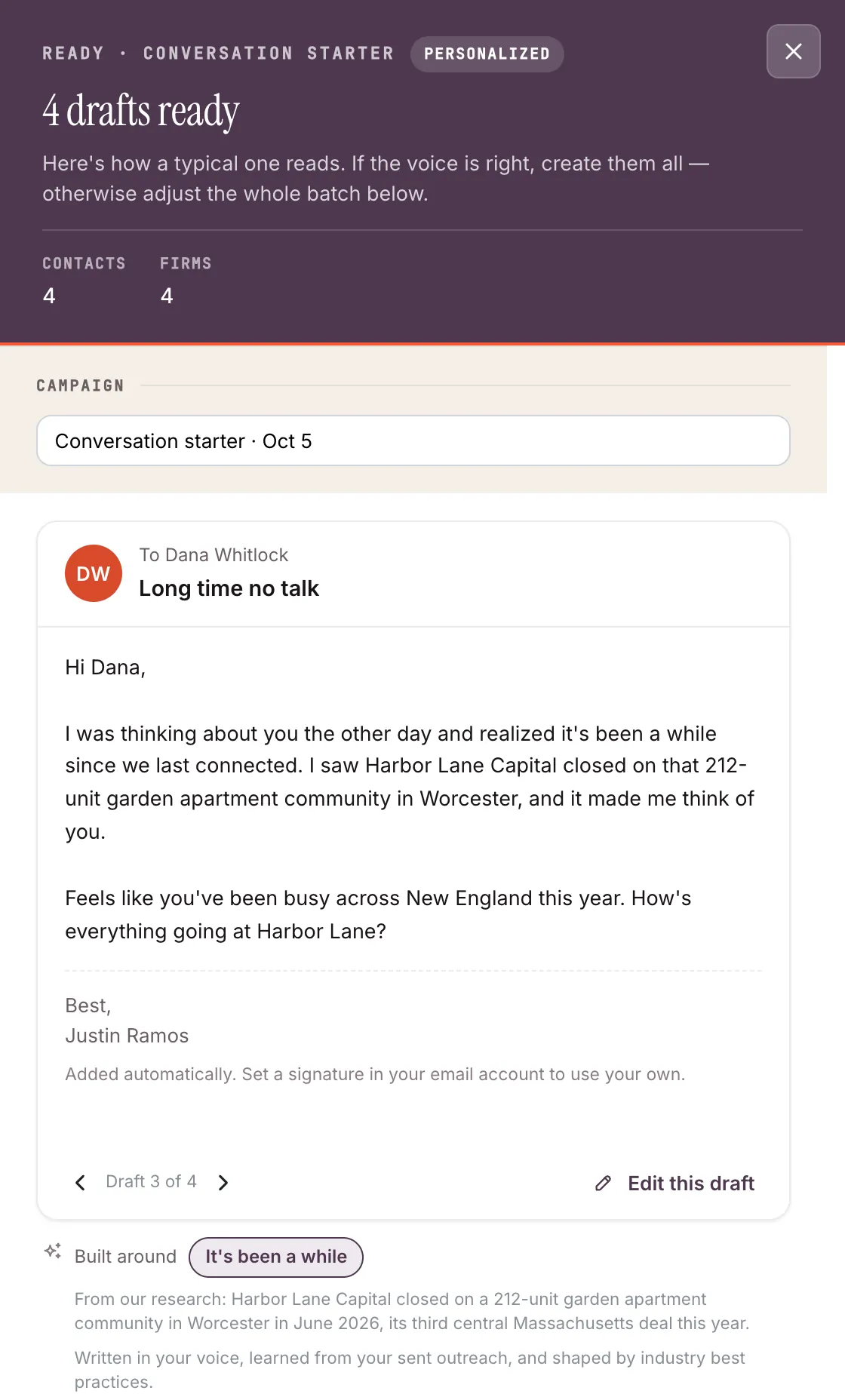
Every hour spent researching someone online or drafting an email is an hour you’re not spending on the human parts of the business, the ones that give you energy. That’s why we built Compai. It handles the 40, in your voice. You do the 11 calls and the 2 coffees. The time doesn’t disappear. It moves to where deals actually happen.
The 40 are only half of it. Compai also helps with the 11 and the 2. Before a call, it tells you who’s waiting on you, what they last asked for, and what you promised but haven’t delivered yet. It brings you a reason to reach out that’s about them, not you. After the coffee, tell it what you learned in thirty seconds, by voice, and it remembers the kids’ names, the lease date and the deal they’re chasing, so next time you pick up right where you left off.
None of this is a hack. It’s the index fund approach applied to your book: small deposits, every week, across everyone you know, for years. That’s the Compounding Book.
Ready to start compounding?
Sources
- MacCarron, Kaski & Dunbar, “Calling Dunbar’s Numbers”, Social Networks (2016)
- Roberts & Dunbar, “Communication in social networks: Effects of kinship, network size, and emotional closeness”, Personal Relationships (2011)
- Levin, Walter & Murnighan, “Dormant Ties: The Value of Reconnecting”, Organization Science (2011)
- Mortgage Bankers Association, “17 Percent of Commercial and Multifamily Mortgage Balances to Mature in 2026” (2026)